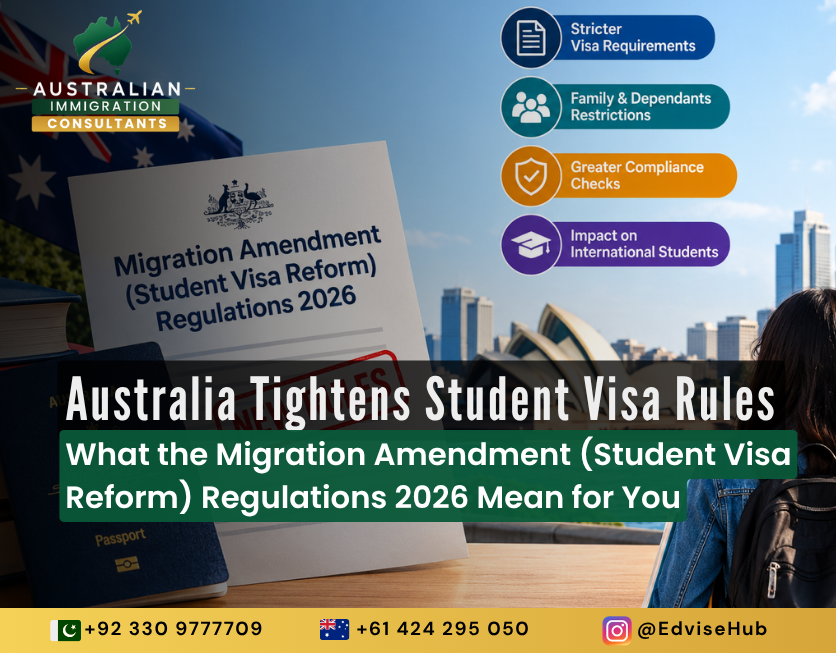
Whether you’re an international student, an education agent, or simply following Australia’s evolving migration landscape, a major update has arrived. On 1 October 2026, the Assistant Minister for Citizenship, Customs and Multicultural Affairs registered the Migration Amendment (Student Visa Reform) Regulations 2026. These regulations amend the Migration Regulations 1994 and make the Subclass 500 (Student) visa considerably harder to use for repeat onshore applications.
What’s behind the reform?
The government wants to stop the Student visa from serving as a “stepping stone” toward long-term stay, where people string together one onshore application after another, a practice often called “visa hopping.” The aim is to bring the visa back to its original purpose: temporary study, not a backdoor to permanent residency.
Two major changes
1. Location of application. Until now, most Student visa applicants could lodge from either onshore or offshore. Under the new rules, a primary applicant who already holds a Student visa and wants another generally must leave Australia before applying. Exemptions cover Defence students, Foreign Affairs students, school students, and any additional group the Minister names in a legislative instrument. Those required to apply offshore must also remain offshore until the visa is granted, so you can’t apply from abroad and then return while the decision is pending.
2. Tighter limits for family members (secondary applicants). Previously, spouses and children could be included in a Student visa application, even after the primary visa was granted (known as a “subsequent entrant” application). Now, secondary applicants can be included only if the primary applicant is a Defence student, a Foreign Affairs student, or a passport holder from a Pacific or ASEAN country. Families who already held, or had applied for, a secondary visa before the rules took effect are protected. Importantly, family members must now apply at the same time and in the same place as the primary applicant. Adding a spouse or child to an existing visa later is no longer possible.
Expert guidance tailored to your unique journey. Get a personalized roadmap from a Registered Migration Agent today.Navigate Your Migration
With Confidence.
Are human rights affected?
The accompanying Statement of Compatibility with Human Rights concedes that the changes touch on family unity (under the ICCPR and the Convention on the Rights of the Child), the right to education (ICESCR), and equality and non-discrimination (ICCPR). The government maintains that none of these rights guarantee entry to or residence in Australia, and that any restriction is reasonable, necessary and proportionate in service of program integrity. Worth noting: the Department consulted the Education and Employment portfolios internally, but non-government organisations were not consulted on this instrument.
When do the changes start?
They apply only to applications lodged on or after commencement, which is the day after registration. Applications already lodged before then will be assessed under the previous rules.
The takeaway: If you’re planning another Student visa application or hoping to bring family, check carefully whether you fit an exemption. For most applicants, the default position is now far stricter.