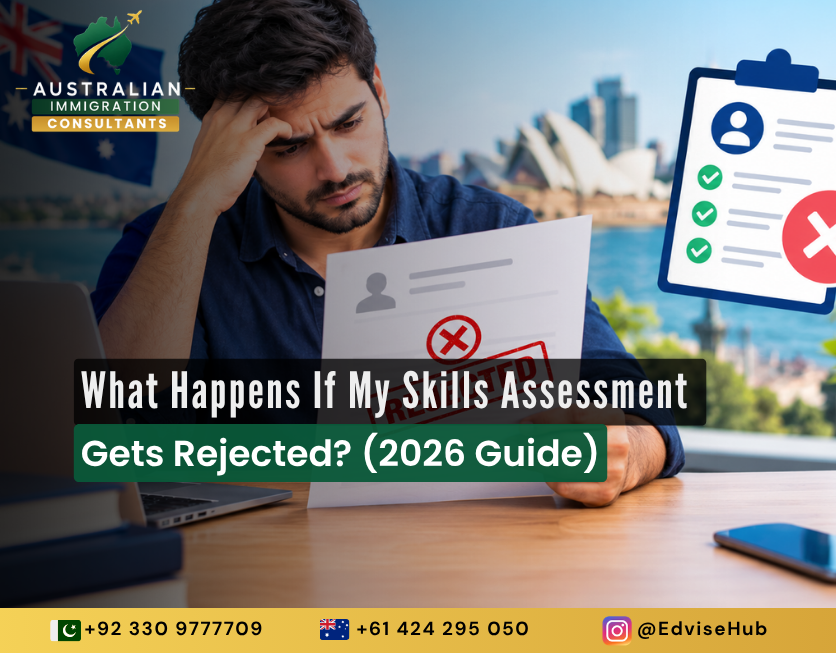
Getting a negative skills assessment outcome feels like a full stop on your Australia PR plans — but it isn’t. Every year, thousands of skilled applicants receive an unsuccessful result from VETASSESS, ACS, Engineers Australia, TRA, or ANMAC, and a large share of them go on to get a positive outcome on review, on appeal, or through a corrected reapplication. The difference between the people who recover from a rejection and the people who give up usually comes down to one thing: understanding why the assessment failed and picking the right pathway to fix it.
This guide walks through exactly what happens after a rejected skills assessment, the options available under each major assessing authority in 2026, realistic timeframes and costs, and how to make sure your next attempt actually succeeds.
Why Skills Assessments Get Rejected
Before deciding what to do next, you need to know which of these applies to you — because the fix is different for each one.
- Work experience doesn’t match the ANZSCO code. The most common reason for rejection. Your job title, duties, and employer reference letters don’t clearly demonstrate the core tasks listed for your nominated occupation.
- Insufficient or vague employment references. Letters that don’t specify duties, hours worked, employment dates, or are not on letterhead are routinely rejected or discounted.
- Qualification not comparable to an Australian standard. Especially common for engineering, IT, and trade occupations where the assessing authority benchmarks your degree or diploma against an AQF-equivalent level.
- Insufficient post-qualification work experience. Many occupations require a minimum number of years of skilled employment after you completed your qualification — general work experience before graduating usually doesn’t count.
- Missing documents or unverifiable evidence. Payslips, tax records, superannuation statements, or organisational charts that don’t corroborate the claimed role.
- English language evidence issues (for some assessing authorities and occupations).
First Steps After a Negative Outcome
- Read the outcome letter line by line. Assessing authorities are required to state the specific reason for refusal — don’t guess.
- Check your deadline immediately. Review and appeal windows are strict and non-negotiable (see the table below).
- Pull together every document connected to the application — the original submission, the outcome letter, and any correspondence.
- Get a second, independent opinion. It’s genuinely difficult to see the gaps in your own file objectively; a registered migration agent reviewing it fresh will often spot what went wrong faster than you can.
Expert guidance tailored to your unique journey. Get a personalized roadmap from a Registered Migration Agent today.Navigate Your Migration
With Confidence.
Your Three Options: Review, Appeal, or Reapply
Once you know why you were rejected, you generally have three paths forward. They are not interchangeable — choosing the wrong one wastes time and money.
A review is usually faster and cheaper than an appeal, and in many cases you can strengthen it with new evidence the original assessor didn’t see. An appeal is the final internal step and generally only looks at whether the review was conducted fairly — it won’t reconsider fresh evidence in the same way. If the rejection reflects a genuine shortfall (not enough qualifying years, for example), a fresh, corrected application — sometimes against a more accurately matched ANZSCO occupation — is usually the faster route to a positive result than fighting a decision that’s technically correct.
Skills Assessment Bodies: Review & Appeal Rules (2026)
Each designated assessing authority runs its own process, deadline, and fee structure. Always confirm current details on the relevant authority’s website before acting, as these change periodically.
Important distinction: A skills assessment rejection is decided by the assessing authority, not the Department of Home Affairs — so it is not reviewed by the Administrative Review Tribunal (ART, which replaced the AAT in 2024). ART only becomes relevant if you go on to lodge a visa application and that visa itself is later refused. Keeping this distinction straight saves a lot of confusion (and wasted time going to the wrong body).
Does a Rejected Skills Assessment Affect My Visa or Future Applications?
A negative skills assessment on its own does not create a visa refusal record and does not trigger an entry ban. It simply means you don’t yet meet the skills criteria for that specific occupation. You can:
- Request a review or appeal with the same authority, or
- Reapply for the same occupation with stronger evidence, or
- Apply for assessment against a different, better-matched occupation
Where it does matter is if you’ve already lodged an Expression of Interest (EOI) or visa application relying on that assessment — in that case, timing becomes critical, since your EOI or visa may need to be updated or withdrawn while the assessment issue is resolved.
How to Strengthen a Reapplication
If a corrected reapplication is your best route, focus on:
- Rewriting employer reference letters to explicitly mirror the ANZSCO duties for your nominated occupation — not just your job title.
- Adding corroborating evidence: payslips, group certificates/tax records, organisational charts, contracts, and a detailed statutory declaration if an employer reference isn’t available.
- Double-checking the occupation match. Sometimes the fix isn’t more evidence — it’s assessing against a different (still eligible) occupation that better reflects your actual role history.
- Confirming you meet the current post-qualification experience threshold for that specific occupation and assessing authority, as requirements are periodically updated.
How Australian Immigration Consultants Can Help
A rejected skills assessment is exactly the kind of setback where an experienced, MARA-registered adviser makes the biggest difference — because the right next step depends entirely on why your specific application failed. At Australian Immigration Consultants, Fahad Shamim (MARN 2619225) and the team review your outcome letter and original documentation to pinpoint the exact refusal reason, then map out whether a review, an appeal, or a corrected reapplication (possibly against a different occupation) gives you the strongest and fastest path to a positive result. We also handle the review/appeal paperwork, help rebuild employer reference letters so they properly reflect ANZSCO duties, and keep your EOI and visa timelines on track while your case is being resolved — so one rejection doesn’t turn into a stalled migration plan.
📩 contact@australianimmigrationconsultants.com | 📞 +61 424 295 050
Frequently Asked Questions
1. Can I appeal a skills assessment rejection? Yes — most assessing authorities offer a review, and if that’s unsuccessful, a formal appeal within a set deadline.
2. How long do I have to request a review after a rejection? It varies by authority, but 90 days from the outcome date is common (e.g. VETASSESS, TRA).
3. Does a rejected skills assessment go to the ART or AAT? No — skills assessments are decided by the assessing authority itself, not the Administrative Review Tribunal.
4. Can I add new documents during a review? Often yes at the review stage (e.g. ACS, VETASSESS), but usually not at the final appeal stage.
5. Will a rejected skills assessment affect my future visa applications? No, on its own it doesn’t create a refusal record or entry ban — it just means you don’t yet meet that occupation’s criteria.
6. Should I reapply instead of appealing? If the rejection reflects a genuine shortfall (e.g. not enough experience), a corrected reapplication is usually faster than an appeal.
7. Can I change my nominated occupation after a rejection? Yes — some authorities will suggest or allow assessment against a different, better-matched occupation.
8. Do I need a migration agent to appeal a skills assessment? It’s not mandatory, but a MARA-registered agent significantly improves your chances by correctly diagnosing the refusal reason first.
Immigration policies and assessing authority processes are updated periodically — always confirm current fees, deadlines, and requirements on the relevant authority’s official website or speak with a registered migration agent before acting.