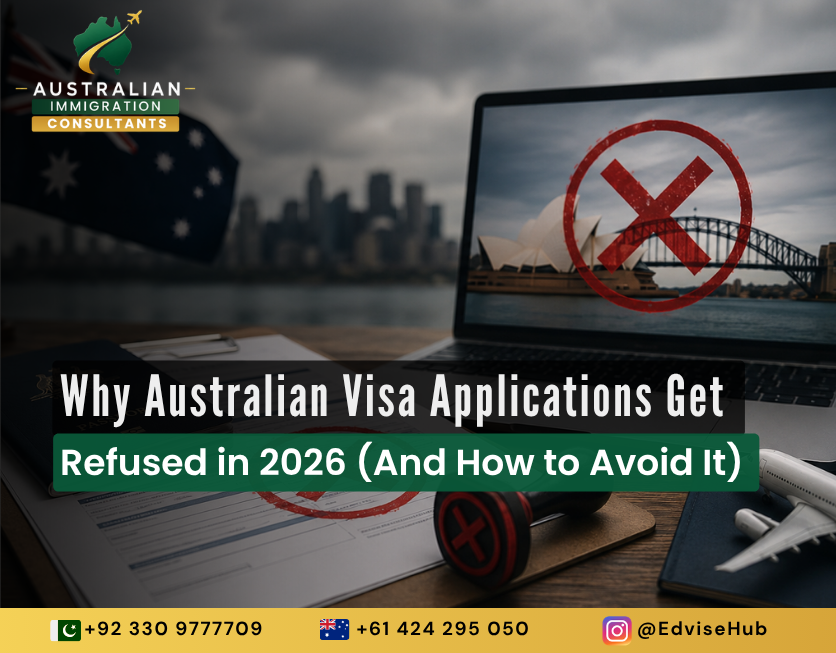
Every year, thousands of people lodge Australian visa applications with genuine intentions, solid documents (they think), and high hopes — only to open ImmiAccount one day and find a refusal notice waiting. In 2026, this isn’t a small-scale problem. Student visa refusal rates are sitting near 20-year highs, skilled visa applicants are getting caught out on points claims that don’t match their evidence, and visitor visa applicants keep tripping over the same “intention to stay temporarily” test that’s existed for decades.
Here’s the part that surprises most people: the majority of Australian visa rejection reasons aren’t about eligibility. They’re about presentation, consistency, and documentation. The Department of Home Affairs isn’t looking for reasons to reject you — but under Section 65 of the Migration Act 1958, if the decision-maker isn’t satisfied every criterion is met, refusal is mandatory. No benefit of the doubt. No second guess. What’s on paper is what gets assessed.
This guide breaks down exactly why Australian visa applications get refused in 2026, the visa application mistakes to avoid, and a practical framework to build a “decision-ready” application the first time.
The Real Reason Refusals Are Rising in 2026
Australia’s migration system has moved from manual review to a heavily automated, cross-referenced verification model. Case officers can now cross-check what you’ve declared on your Australian application against records from other countries (including Five Eyes partners — UK, US, Canada, NZ), previous visa applications, and government databases in real time.
Practically, this means:
- Inconsistencies that used to slip through are now flagged instantly
- Financial “padding” (large unexplained deposits before lodgement) gets noticed
- Declaring different job titles, study intentions, or personal details across different applications creates red flags
- AI-assisted document verification checks academic transcripts, bank letters, and employment references against known formats and issuing institutions
In short: the system got smarter. Most applicants didn’t adjust their approach to match it. That gap is where refusals happen.
Visa Refusal Reasons Australia: The Core Categories
1. Incomplete or Inconsistent Documentation
This is consistently the single biggest driver behind Australia visa rejection reasons across every stream — student, visitor, skilled, and family visas. Missing bank statements, outdated identity documents, unverified translations, or forms with mismatched personal details (spelling of your name, date of birth, previous visa numbers) can trigger a refusal before a case officer even gets to assess your actual eligibility.
Fix: Cross-check every document against your application form line by line before submission. If a translation is required, use a NAATI-certified translator — not a friend who “speaks the language well.”
2. Insufficient or Unclear Financial Evidence
The Department needs to see that you can genuinely support yourself (and any dependents) for the length of your stay. For Student visa (subclass 500) applicants specifically, current financial capacity requirements sit at AUD 29,710 per year for living costs, on top of tuition and return airfare — and this figure is reviewed periodically, so it should always be confirmed directly on immi.homeaffairs.gov.au before lodging.
Refusals commonly happen when:
- Bank statements are too recent or show a sudden, unexplained lump sum
- Sponsor income doesn’t clearly meet the threshold
- Funds are shown in a currency or account structure that’s hard to verify
Fix: Build your financial evidence gradually, well ahead of lodging. Sudden deposits without a documented source (inheritance, sale of property, business income) look exactly like “financial padding” to a case officer — even when the money is completely legitimate.
Expert guidance tailored to your unique journey. Get a personalized roadmap from a Registered Migration Agent today.Navigate Your Migration
With Confidence.
3. Failing the Genuine Student (GS) Requirement
Since 23 March 2024, the Genuine Student requirement has replaced the old Genuine Temporary Entrant (GTE) test for all Subclass 500 applications. Unlike GTE, GS doesn’t require you to prove you’ll leave Australia — it actually acknowledges that students may go on to apply for permanent residence after gaining skills Australia needs. But it does require you to demonstrate that your course choice, career goals, and personal circumstances genuinely align.
Common refusal triggers here:
- Enrolling in the cheapest available course with no real link to your career background
- GS statement responses that are vague, generic, or copy-pasted from a template
- No clear explanation of why Australia (versus your home country or another destination) makes sense for this specific course
Fix: Your GS responses (each limited to 150 words per question) need to read as a coherent story — your academic background, why this specific course, and how it logically connects to your future goals. Home Affairs gives more weight to statements that are backed by supporting evidence, not just declarations.
4. Points Claims That Don’t Match the Evidence (Skilled Visas)
For skilled visa pathways, refusals often come down to a gap between what’s claimed in the EOI/application and what the supporting documents actually prove — inconsistent employment dates, skills assessment outcomes that don’t align with the nominated occupation, or work experience letters that don’t match payslips or tax records.
Fix: Every point you’re claiming — English proficiency, skilled employment, qualifications — needs a document trail that a stranger could verify without needing to ask you a single follow-up question.
5. Weak Ties to Home Country (Visitor Visas)
For Visitor visa (subclass 600) applications, the Department is assessing whether you genuinely intend to stay temporarily. If your employment is new, unstable, or undocumented, or your travel history shows a pattern of long overseas stays, officers may conclude there’s a real risk of overstay.
Fix: Include a job letter with dates and approved leave, payslips matching your bank activity, and any anchors — property, ongoing study, family, or business ties — that support a credible reason to return.
6. Health and Character (PIC 4020, Ministerial Direction 110)
Public Interest Criterion 4020 is one of the most serious grounds — providing false or misleading information, even unintentionally, can result in refusal and, in more serious cases, exclusion periods from future applications. Character requirements under current Ministerial Direction guidance mean any criminal record (even minor or “spent”) must be declared, and undeclared prior visa refusals from any country are treated as a character issue, not just an oversight.
Fix: Declare everything. A previous refusal, no matter how long ago or from which country, does not automatically block a future visa — but failing to disclose it can.
7. OSHC/Health Cover Misalignment
Student and select temporary visa holders must maintain valid health cover for the entire visa duration. Refusals happen when cover dates don’t align with the requested visa period, or coverage is too basic to meet minimum requirements.
Fix: Match your OSHC/OVHC start and end dates exactly to your intended visa period — not just your course dates.
8. Using the Wrong Visa Pathway for Your Situation
A surprising number of refusals happen simply because applicants choose a subclass that doesn’t fit their real circumstances. Someone whose primary goal is long-term migration but who applies on a short-stay visitor visa, or a skilled worker who nominates an occupation their skills assessment doesn’t actually support, is setting the application up to fail regardless of how well the paperwork is prepared.
Fix: Map your goals to the correct pathway before you touch the application form. A visa that technically lets you enter Australia isn’t the same as a visa that matches your actual intent — and mismatches here are exactly what trigger genuine-intention scrutiny later.
Why “Good Enough” Documents Aren’t Good Enough Anymore
A few years ago, a slightly disorganised application with minor gaps might still get approved, especially if a case officer had room to ask a clarifying question. In 2026, that margin has shrunk considerably. Applications are increasingly expected to be “decision-ready” the moment they’re lodged — meaning every claim is backed by a document, every document is internally consistent, and nothing requires the Department to chase you for clarification.
This shift matters because Requests for Information (RFIs) are no longer treated as a routine part of the process — they’re often the last checkpoint before a refusal. A slow, incomplete, or inconsistent RFI response can turn a fixable gap into a final rejection. The applicants who avoid this outcome are the ones who treat the first submission as if it were their only chance — because increasingly, it is.
How to Avoid Visa Refusal Australia: A Practical Checklist
- Start documentation early. Financial evidence especially needs weeks (ideally months) to build a clean, explainable trail.
- Keep every application consistent. Job titles, dates, and personal details should match across every visa application you’ve ever lodged, in any country.
- Never leave a question blank or vague. Case officers assess what’s in front of them — ambiguity gets read as a gap, not a green light.
- Use the Department’s own Document Checklist Tool on immi.homeaffairs.gov.au to confirm exactly what’s required for your specific subclass.
- Respond to Requests for Information (RFIs) immediately and fully. A slow or partial RFI response is one of the fastest routes to refusal.
- Get professional documents professionally verified — certified translations, real skills assessments, and legitimate financial letters, not shortcuts.
- Declare every past refusal or visa cancellation, from any country. Non-disclosure is treated far more seriously than the refusal itself.
What Happens If Your Visa Is Refused?
If your visa is refused, the letter you receive in ImmiAccount will state whether you have review rights. Since 14 October 2024, the Administrative Review Tribunal (ART) has replaced the former Administrative Appeals Tribunal (AAT) as the body reviewing eligible migration decisions. Review deadlines are strict — typically between 7 and 28 days from the refusal date — so acting quickly matters. Not every refusal decision is reviewable, and the current fee for a reviewable migration decision under Part 5 is significant, so it’s worth understanding your options clearly before deciding whether to reapply or seek review.
How Australian Immigration Consultants Can Help
- Reviews your documents against the exact requirements for your visa subclass before you lodge
- Helps build a consistent, evidence-backed Genuine Student statement or points claim
- Flags financial evidence gaps or inconsistencies before a case officer ever sees them
- Guides you through Requests for Information (RFIs) and, where applicable, review pathways after a refusal
- Keeps advice grounded in current Department of Home Affairs requirements, not outdated forum posts
8 Frequently Asked Questions
What is the most common reason Australian visa applications get refused? Incomplete, inconsistent, or unverifiable documentation is the leading cause across almost every visa subclass.
Can I reapply for an Australian visa after a refusal? Yes — a single refusal doesn’t permanently block future applications, but it must always be declared.
How long do I have to appeal a visa refusal in Australia? Typically between 7 and 28 days from the refusal date, as stated in your refusal letter.
Which body reviews Australian visa refusal decisions now? The Administrative Review Tribunal (ART), which replaced the AAT on 14 October 2024.
Does a visa refusal affect future applications? It doesn’t automatically block you, but failing to declare it can lead to a much more serious refusal under character grounds.
What is the Genuine Student requirement for a student visa? It’s the assessment (replacing GTE since March 2024) that checks whether your course, background, and goals genuinely align.
How much money do I need to show for an Australian student visa in 2026? At least AUD 29,710 per year for living costs, plus tuition and return airfare, subject to periodic review.
Can unintentional false information still lead to a refusal? Yes — under PIC 4020, even unintentional false or misleading information can result in refusal.
This article is for general informational purposes and reflects publicly available Department of Home Affairs guidance as of August 2026. Requirements change frequently — always confirm current criteria at immi.homeaffairs.gov.au before lodging your application.