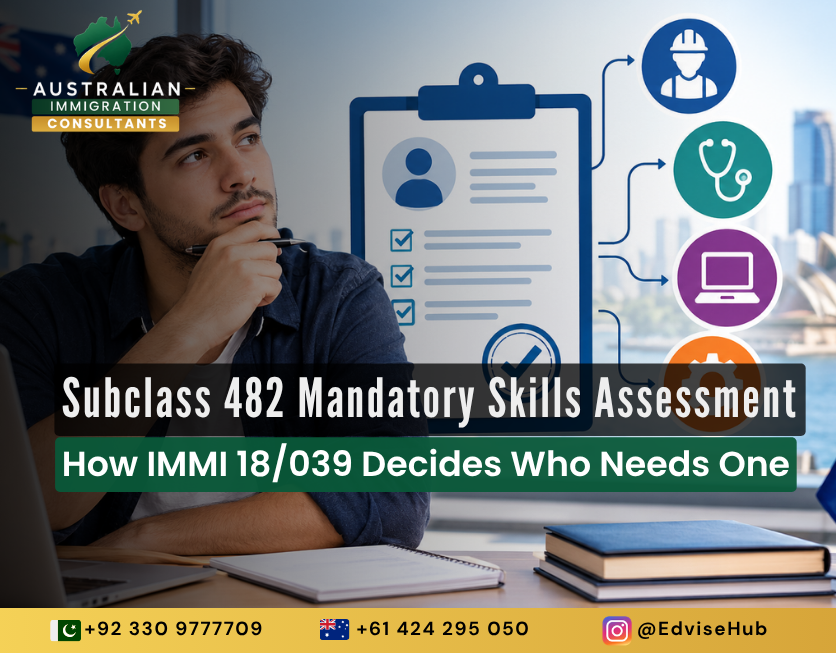
Plenty of employers and overseas workers assume that every Subclass 482 (Skills in Demand) application comes with a compulsory skills assessment. It does not. Whether one is required is settled by a short legislative instrument called IMMI 18/039, and the answer changes from one applicant to the next depending on trade, passport and background.
This guide reads the instrument section by section and shows how the pieces fit together. We have kept the explanation plain but tied each point to the section it comes from, so you can check the source yourself.
Before you rely on this: the article reflects Compilation No. 2 of the instrument, which states the law as at 14 December 2024 (Federal Register of Legislation ID F2025C00062). Instruments get amended, so confirm the latest compilation on legislation.gov.au before acting on anything below.
Why the Regulations point to a separate instrument
The Migration Regulations 1994 make a skills assessment compulsory for some 482 applicants, but they stop short of saying which occupations, which assessing bodies or which people are affected. That detail is delegated to a legislative instrument. IMMI 18/039, formally the Migration (IMMI 18/039: Mandatory Skills Assessment—Subclass 482 Visa) Instrument 2018, fills the gap. It is made under subregulation 2.26B(1) and paragraph 1240(3)(g) of Schedule 1 to the Regulations.
In practice the instrument does four jobs. Section 5 lists the occupations and names the assessing authority and assessment type for each. Section 6 identifies the class of people caught, mostly by reference to the passport they hold. Section 7 explains who is exempt. Section 8 deals with timing for amendments.
It has been changed since 2018. LIN 24/094 commenced on 7 December 2024, the same day the Skills in Demand visa arrived, and section 8 confirms its amendments apply to applications made on or after that date. LIN 24/083 followed, updating the assessing authorities from 14 December 2024.
Whose application it targets
Both section 5(1) and section 6(1) speak to a person seeking to satisfy the primary criteria for the Subclass 482 (Skills in Demand) visa. That means the sponsored worker. Family members applying as secondary applicants are not the focus of this instrument.
A three-gate test
The instrument works like a series of gates. First, the nominated occupation must be on the list. Second, the applicant’s passport must put them in the class specified for that occupation. Third, the applicant must not be an exempt applicant. Only someone who gets through all three gates needs the assessment, and it must then fall within the 3 years ending immediately before the day the application is made.
Keep that sequence in mind as you read on, because each section below is one gate.
Expert guidance tailored to your unique journey. Get a personalized roadmap from a Registered Migration Agent today.Navigate Your Migration
With Confidence.
Gates one and two: your trade and your passport
Section 5 lists 24 occupations. The ANZSCO codes are given for information only, and the version used is the one in force on 23 November 2022. The item numbers skip from 22 to 24 because item 23 was repealed by LIN 24/094 and the numbering was left untouched.
Skilled Occupations and Assessing Authorities
Being on this list is only the first hurdle. The mandatory assessment applies only to people in the class specified for the occupation, and for every occupation except one, that class is defined by the passport you hold (exempt applicants are carved out). Several trades share the same passport list, so the table below groups them.
Occupations and Passports in the Class
A few things stand out when you read the table. The test is the passport you hold when you apply, not nationality in a general sense. If your passport is absent from the list for your occupation, this instrument does not require an assessment from you for that occupation. Chefs and cooks carry the longest list of any trade, and Bangladesh, Nepal and Pakistan show up nowhere else. Program or project administrator breaks the pattern completely: it is not passport-based, so everyone is caught unless they qualify as an exempt applicant under that occupation’s own test.
Which assessment, and how fresh must it be
For every TRA occupation, the instrument accepts either an SID Skills Assessment or a TSS Skills Assessment. TRA covers 23 of the 24 occupations. Program or project administrator is the exception, and it goes to VETASSESS for its Skills Assessment for General Professional Occupations.
On timing, the instrument looks at the 3 years ending immediately before the day the application is made. An older assessment may sit outside that window, so check its date before relying on it.
Gate three: the exemptions in section 7
Falling into the class is not the end of the road. An exempt applicant is outside the class, and the requirement does not apply. Section 7 sets out six routes.
Already on a sponsored visa (s 7(1)(a)). You qualify if you hold a Subclass 457, a Subclass 482 (Temporary Skill Shortage) or a Subclass 482 (Skills in Demand) visa, you met the primary criteria for it, and you are working in Australia in the nominated occupation the new application relates to. That last element ties the exemption to the same occupation, so a change of occupation needs fresh analysis.
Intra-company transfers (s 7(1)(b)). You qualify if you work for a company with an established business overseas, in the same or a similar occupation to the nominated one, and you are nominated by a standard business sponsor that is that company or an associated entity.
Relevant qualification (s 7(2)(a)). Available for every listed occupation except program or project administrator. You need a qualification commensurate with the one ANZSCO specifies for the occupation, gained by completing a course of study or training in Australia or in a “permitted country”. Under section 7(3), a permitted foreign country is any foreign country, or Special Administrative Region, that is not named in the passport list for your occupation. A qualification from a listed country will not support this exemption.
Licence, registration or membership (s 7(2)(b)). Again excluding program or project administrator. The occupation must require a licence, registration or membership in order to be performed, and you must have been granted it.
TRA Offshore Skills Assessment Program (s 7(2)(c)). Also excluding program or project administrator. You are exempt if you have met the standards TRA sets under that program for the nominated occupation.
Program or project administrator (s 7(4)). Since the other routes are closed to this occupation, it has its own test. You need a relevant qualification commensurate with the ANZSCO qualification, annual earnings of at least AUD 180,000, and a nomination from a standard business sponsor with accredited status granted by the Department. All three must be met.
Five short scenarios
These are simplified and hypothetical, and none is advice for a real case.
A chef holding a Pakistani passport is on a listed occupation and in the class. With no qualifying qualification, no required licence and no section 7(1) exemption, a TRA assessment is needed. If that same chef had completed an Australian course commensurate with the ANZSCO qualification, the qualification exemption could apply and the assessment would fall away.
A carpenter holding a New Zealand passport is outside the class, because New Zealand is not on the carpenter list. The instrument does not require an assessment.
A first class welder already on a 482 visa, working as a welder and applying for another 482 in the same occupation, may fit the existing sponsored worker exemption.
A program or project administrator on a lower salary is in the class simply because everyone is. Unless all three limbs of section 7(4) are met, a VETASSESS assessment is required.
When the assessment is still pending at lodgement
As we read the Migration Regulations, an applicant in the Specialist Skills or Core Skills stream may also meet the requirement by having arranged an assessment with the relevant authority that has not yet been completed when the application is made. The Regulations add that this does not limit the separate skills requirements in Schedule 2. Treat it as a timing allowance and confirm the exact wording, and what must be held by decision stage, before you lodge.
Where applications tend to go wrong
The most frequent error is assuming every 482 applicant needs an assessment, when passport and exemptions take many people out of the requirement. A close second is looking at occupation alone and forgetting the passport gate. Others include leaning on an assessment older than the 3-year window, reading the qualification exemption too loosely (it needs ANZSCO-commensurate study in Australia or a permitted country, not just any degree), forgetting that the existing sponsored worker exemption is tied to the same nominated occupation, and working from an outdated compilation.
A checklist for sponsors
Employers can avoid most of these problems by fixing the nominated occupation early, since everything else flows from it. Next, collect the candidate’s passport details and compare them against the correct occupation list. If an exemption is being claimed, gather the evidence at the start: qualification documents, licence or registration proof, current visa details, intra-company records, or, for program or project administrators, salary and sponsor accreditation records. Finally, allow for assessment turnaround time in the recruitment timeline.
FAQS
Does this apply to secondary applicants?
No. It applies to people seeking to satisfy the primary criteria.
Who carries out the assessment?
TRA for 23 of the 24 occupations, VETASSESS for program or project administrator.
What type does TRA accept?
Either an SID Skills Assessment or a TSS Skills Assessment.
Does a licence automatically make me exempt?
Only where the occupation requires a licence, registration or membership and you have been granted it.
Does an overseas qualification count?
Only if it is commensurate with the ANZSCO qualification and was gained in a permitted country for that occupation, meaning one not on your occupation’s passport list.
Is this the Core Skills Occupation List?
No. It is a separate list that only identifies where a mandatory skills assessment can be required.
Not sure which side of the three gates you or your candidate falls on? The Australian Immigration Consultants team can check occupation, passport and exemption options before anything is lodged. Reach out through australianimmigrationconsultants.com.
This article is general information only and is not migration advice for your circumstances. Migration law changes often. Check the current legislation and Department of Home Affairs guidance, or speak with a Registered Migration Agent, before making decisions or lodging an application.