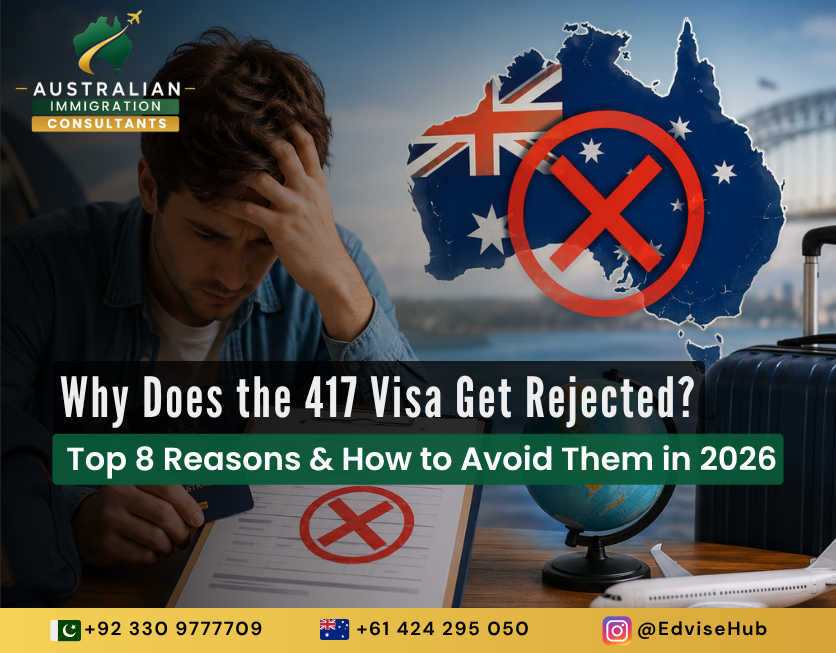
Quick answer: Most 417 visa rejected cases in 2026 come down to eight avoidable issues — incomplete documents, insufficient funds, failed character or health checks, inconsistent information, ineligible passport/age status, incorrect second/third-year work evidence, genuine-entrant doubts, and application errors. Fix these before you submit, and your approval odds go up dramatically.
If you’re staring at a refusal notice — or trying to make sure you never get one — you’re not alone. The Working Holiday visa (subclass 417) looks simple on paper: no points test, no employer sponsor, no IELTS. But “simple” doesn’t mean “hard to mess up.” Every year, thousands of working holiday hopefuls from the UK, Ireland, Germany, France, Canada, Japan, South Korea, and other eligible countries get caught out by small, fixable mistakes.
Let’s break down exactly why the 417 visa refused decisions happen, and what you can do differently.
First, What Actually Triggers a Refusal?
The Department of Home Affairs doesn’t publish a subclass-specific refusal rate for the 417 the way it does for some skilled visas, so treat any “417 visa refusal rate 2026” figure you see floating around online with caution unless it links directly back to Home Affairs data. What we do know, from case patterns and registered migration agents, is that refusals are rarely about complicated legal grounds. They’re almost always about a checklist item that got missed.
Here’s the honest breakdown of what’s actually going wrong.
1. Passport or Age Ineligibility
The 417 visa is only open to passport holders from specific countries, and age limits differ by nationality — generally 18 to 30, extended to 18–35 for citizens of Canada, Denmark, Ireland, Italy, and the UK. Applying with the wrong passport, or applying after your eligible birthday cutoff, is an instant knockout. From 1 July 2026, Home Affairs also added Cyprus, Finland, Germany, and South Korea to the list of countries eligible for the extended 18–35 age bracket, so double-check the current list before you assume you’re locked out — or locked in.
Fix: Confirm your exact age bracket for your passport country on the official Home Affairs 417 page before you pay a single dollar.
Navigate Your Migration
With Confidence.
Expert guidance tailored to your unique journey. Get a personalized roadmap from a Registered Migration Agent today.

2. Insufficient Funds Evidence
Home Affairs expects applicants to show they can support themselves — commonly cited around AUD 5,000 in accessible funds — without relying on illegal work. Screenshots of a mobile banking app, funds sitting in someone else’s account, or a balance that spiked right before applying (and looks staged) are common red flags.
Fix: Use official, dated bank statements in your own name, and let the balance sit stable for a reasonable period before applying.
3. Character and Police Clearance Issues
Under Section 501 of the Migration Act, applicants must pass a character test. Undisclosed criminal history — even minor or old offences — is one of the most common working holiday visa 417 rejection reasons, not because the offence itself is always disqualifying, but because non-disclosure is treated far more seriously than the original issue.
Fix: Disclose everything, get police certificates from every country you’ve lived in for 12+ months in the last 10 years, and don’t assume Home Affairs won’t check.
4. Health Requirement Failures
Depending on your planned activities and length of stay, you may need a medical exam. Some conditions can trigger refusal if no health waiver applies to the subclass — and for many temporary visas, no waiver exists at all.
Fix: Complete any requested health examinations promptly through your ImmiAccount instructions, and be upfront about pre-existing conditions rather than hoping they go unnoticed.
5. Genuine Temporary Entrant Doubts
Home Affairs wants to see that you intend a genuine working holiday — not a backdoor route to long-term settlement. Vague travel plans, no return intention, or an application that reads like a permanent migration attempt in disguise can raise doubts, especially if your file already shows prior visa refusals or overstays elsewhere.
Fix: Keep your application honest and consistent with the working holiday purpose — travel, cultural exchange, and short-term work, not permanent relocation.
6. Incomplete or Inconsistent Documentation
This is the single biggest bucket of 417 visa refused reasons in practice. Missing passport bio pages, mismatched name spellings across documents, unclear scanned uploads, or forms filled out in a rush all create friction — and friction creates delay, requests for more information, or outright refusal.
Fix: Build a full 417 visa documents checklist before you start the online form (see below).
7. Second and Third-Year Visa Work Evidence Errors
If you’re applying for a second or third Working Holiday visa, you need to prove you completed specified/regional work in an eligible postcode and industry. Incorrect postcode classification, unpaid or undocumented “cash-in-hand” work, or work in a non-qualifying industry is a very common reason second and third-year applications get knocked back.
Fix: Verify your workplace’s postcode and industry against the official Home Affairs regional work list before you rely on it for your extension.
8. Application and Payment Errors
Sometimes it really is this simple — an unpaid fee, a form submitted with a section left blank, or applying from inside Australia when you’re required to be offshore for a first 417 application. Small, procedural, and completely avoidable.
Fix: Read every section of the ImmiAccount form twice. Don’t submit on autopilot.
417 Visa Documents Checklist
Before you hit submit, have these ready:
| Document | Why It Matters |
|---|---|
| Valid passport (bio page, eligible country) | Confirms nationality and validity for the full stay |
| Proof of funds (~AUD 5,000, official statements) | Shows self-sufficiency |
| Police clearance certificates | Confirms character requirement |
| Health examination results (if requested) | Confirms health requirement |
| Health insurance details | Strongly recommended, sometimes essential |
| Evidence of specified work (2nd/3rd year only) | Confirms postcode + industry eligibility |
| Consistent personal details across all documents | Prevents GTE and identity red flags |
Why Is My 417 Visa Taking So Long?
This is one of the most searched questions right now, and the honest answer is: it depends on your file’s complexity. Official guidance suggests around 75% of 417 applications are processed within 24 hours, but files needing extra checks — health exams, character assessments, or unclear documentation — can stretch toward the higher end of the published window. Home Affairs has also flagged that it’s currently receiving a high volume of Working Holiday (subclass 417) and Work and Holiday (subclass 462) visa applications, meaning applications are taking longer than usual to be finalised. If your file has been sitting for weeks with no update, it usually means it’s been flagged for manual review — not necessarily heading for refusal.
Don’t book flights until you have written confirmation of grant — Home Affairs is explicit about this, and it protects you from non-refundable losses if something’s still pending.
Can I Reapply for a 417 Visa After Refusal?
In most cases, yes — you can reapply after a refusal, unless the refusal involved false or misleading information (Public Interest Criterion 4020), which can trigger a multi-year exclusion period. The smarter move before reapplying is to actually read your refusal letter line by line and fix the exact issue cited, rather than resubmitting the same application with minor tweaks and hoping for a different outcome.
How to Avoid 417 Visa Rejection: The Real Strategy
- Match your passport and age to current eligibility rules — these do change, as the 2026 country additions show.
- Don’t rush the ImmiAccount form. Errors here are one of the most preventable 417 visa common mistakes.
- Keep your finances clean and documented, not last-minute.
- Be transparent about character and health matters — hiding something is worse than disclosing it.
- For second/third-year applicants, confirm your work counts before you rely on it.
- Get a second set of eyes on your file if anything about your situation is complicated — a prior refusal, a criminal record, or unclear regional work history.
That last point is where a lot of applicants quietly go wrong — not because the visa is legally complex, but because it’s easy to be overconfident about a “simple” visa until your own file has a wrinkle in it. This is where working with a MARA-registered adviser like Australian Immigration Consultants can help — reviewing your documents against current Home Affairs requirements before you submit, rather than after you’ve already received a refusal letter.
FAQs
Why do working holiday visas get rejected in Australia? Most refusals stem from incomplete documents, insufficient funds evidence, character or health issues, or genuine-entrant doubts.
What documents are needed for a 417 visa application? A valid eligible passport, proof of funds, police clearances, health results if requested, and (for extensions) evidence of specified regional work.
Can I reapply for a 417 visa after refusal? Yes in most cases, unless the refusal involved false or misleading information, which can trigger a multi-year reapplication ban.
How long does a 417 visa take to process in 2026? Many straightforward applications are decided within 24 hours to a few weeks, though high volumes are currently extending timelines for some files.
Why is my 417 visa taking so long? Your file likely needs extra checks — health, character, or unclear documentation — or is caught in a current high-volume processing period.
What’s the 417 visa refusal rate in 2026? Home Affairs doesn’t publish an official subclass-specific refusal rate, so most quoted “rates” online aren’t from a verifiable government source.
Disclaimer: This article provides general information sourced from official Department of Home Affairs guidance and is not personal migration advice. Visa criteria change regularly — always confirm current requirements on the official Home Affairs website or consult a registered migration agent before applying.