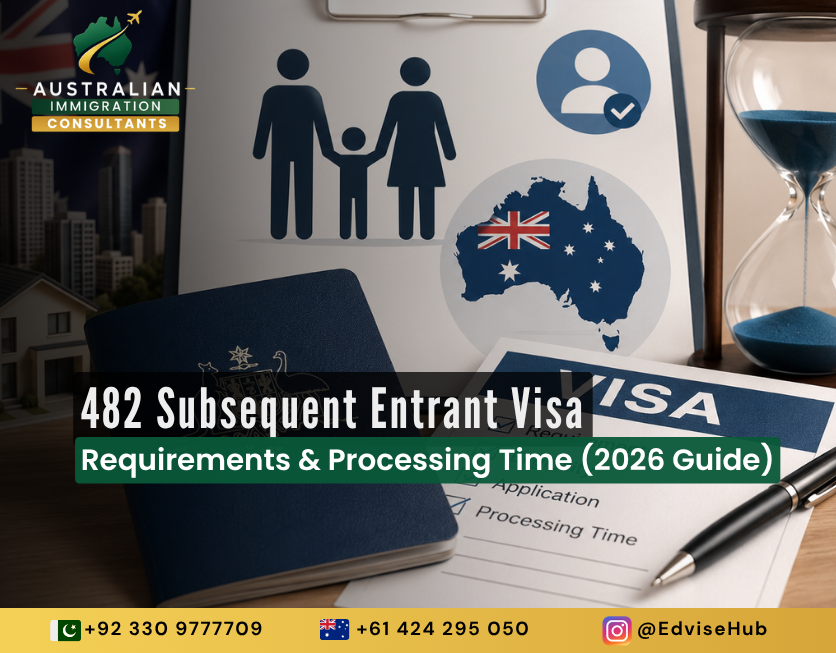
If you’re the spouse, de facto partner, or child of a Subclass 482 Skills in Demand visa holder, you don’t have to wait years to reunite in Australia. The 482 Subsequent Entrant visa lets eligible family members join a primary visa holder after their visa has already been granted — and with the right documentation, it doesn’t have to be a slow or confusing process.
This guide covers everything you need to know about the 482 subsequent entrant visa requirements, processing time, fees, and eligibility — based on the latest published information from the Department of Home Affairs — so you know exactly what to expect before you apply.
What Is the 482 Subsequent Entrant Visa?
The 482 Subsequent Entrant visa isn’t a separate visa subclass — it’s a subsequent entrant application made under the Skills in Demand (subclass 482) visa program (the visa that replaced the old Temporary Skill Shortage visa in December 2024). It allows a “member of the family unit” of a current — or former subclass 457 — primary visa holder to be granted their own subclass 482 visa so they can live, work, and study in Australia alongside their family member.
In simple terms: your partner or parent got their 482 visa first, and now you’re applying separately to join them.
Who Counts as a Member of the Family Unit?
Under Australian migration law, you may be eligible as a subsequent entrant if you are:
- The legally married spouse of the primary visa holder
- The de facto partner of the primary visa holder
- A dependent child (under 18, or over 18 in limited circumstances such as full-time study or a disability) of the primary visa holder or their partner
Parents, siblings, and extended family members do not qualify under this category — this is one of the most common misconceptions applicants search for.
482 Subsequent Entrant Visa Requirements
Meeting the eligibility criteria properly the first time is the single biggest factor in avoiding delays. Here’s what the Department of Home Affairs generally requires:
1. Relationship Evidence
You must prove a genuine relationship with the primary visa holder. This includes:
- Marriage or de facto relationship certificates
- Joint bank accounts, leases, or utility bills
- Photos, travel records, and communication history spanning your relationship
- Birth certificates or legal custody/adoption documents for dependent children
Expert guidance tailored to your unique journey. Get a personalized roadmap from a Registered Migration Agent today.Navigate Your Migration
With Confidence.
2. Sponsor’s Written Agreement
The primary visa holder’s approved sponsor (employer) must agree in writing to include the family member(s) in the nomination. Without this endorsement, a subsequent entrant application cannot proceed.
3. Health Requirements
All subsequent entrants must meet Australia’s health requirements, which typically involves:
- A medical examination
- A chest X-ray (for applicants over a certain age)
- Additional tests if flagged by the panel physician
Health exams must be completed through an approved panel physician recognised by the Department of Home Affairs. Failing to meet health standards can lead to refusal unless a health waiver applies.
4. Character Requirements
Applicants aged 16 and over must meet character requirements, which usually means providing police clearance certificates from every country they’ve lived in for 12 months or more (cumulatively) in the past 10 years since turning 16.
5. Health Insurance
Subsequent entrants must hold adequate health insurance for the duration of their stay, unless they’re covered under a reciprocal healthcare agreement.
6. English Language and Values Statement
Depending on the visa stream and nationality, adult applicants may need to demonstrate functional English (or pay a Second Instalment Visa Application Charge if they can’t). Dependants aged 18+ must also sign the Australian Values Statement.
7. No Outstanding Debts to the Australian Government
Applicants must not owe debts to the Commonwealth, and must generally hold a substantive or eligible bridging visa if applying while onshore.
482 Subsequent Entrant Visa Processing Time
This is the question almost every applicant searches for — and the honest answer is: there’s no fixed processing time. The Department of Home Affairs assesses every 482 subsequent entrant application individually, based on its own complexity and completeness.
That said, based on current published trends and the Department’s global visa processing time data:
- Most decision-ready 482 subsequent entrant applications are finalised in 30 to 47 days (roughly 4–8 weeks)
- More complex cases — involving missing documents, additional health checks, or multiple police clearances — can take several months
- The Specialist Skills stream generally receives faster processing than the Core Skills stream, which is assessed in order of lodgement
- Applications are prioritised according to Ministerial Direction, which favours regional employer sponsorship, healthcare and teaching occupations, and accredited sponsors
What Actually Slows Down Processing?
| Factor | Impact on Processing Time |
|---|---|
| Missing or incomplete documents | Most common cause of delay |
| Health examination delays | Can add several weeks |
| Police clearances from multiple countries | Time-consuming to obtain |
| Slow response to Department requests | Can add months to your timeline |
| Primary visa holder’s nomination not yet approved | Subsequent entrant application cannot be finalised first |
Pro tip: Complete your health examination and gather police clearance certificates before lodging. A fully “decision-ready” application is the single most effective way to avoid unnecessary delays.
To check current published timeframes, always refer to the Department’s Global Visa Processing Times tool, as these figures are updated regularly.
482 Subsequent Entrant Visa Fees (2025–26)
Visa Application Charges (VAC) for subsequent entrants are typically higher than for family members included in the original nomination, since they are applying under a separate subsequent applicant charge. As of the Department’s most recent fee update:
- Primary applicant (subsequent entrant, e.g. partner): approximately AUD 3,200–4,015
- Each additional applicant aged 18 and over: similar to the above
- Each additional applicant aged under 18: approximately AUD 800–1,005
- Onshore lodgement: may attract an additional Subsequent Temporary Application Charge (STAC) of around AUD 700 per person
Fees are indexed and change every 1 July, so always confirm the exact current amount on the official Home Affairs fee schedule before lodging, as third-party estimates can go out of date quickly.
How Long Can You Stay on a 482 Subsequent Entrant Visa?
Your visa validity is directly tied to the primary visa holder’s visa. If your partner’s 482 visa is valid for four years, your subsequent entrant visa will generally align with that same expiry date. Once granted, you can typically:
- Live in Australia for the remaining validity period of the primary visa
- Work in any occupation (no restriction tied to the primary applicant’s nominated role)
- Study in Australia
- Access Medicare if a Reciprocal Health Care Agreement applies
How to Apply: Step-by-Step
- Confirm eligibility — verify your relationship qualifies under “member of the family unit.”
- Get sponsor endorsement — the employer sponsor must agree in writing to add you to the nomination.
- Gather documentation — relationship evidence, identity documents, police clearances, health insurance proof.
- Complete health examinations through an approved panel physician.
- Create or log into ImmiAccount at online.immi.gov.au and select the Skills in Demand (subclass 482) visa application for subsequent entrants.
- Pay the visa application charge and submit supporting documents.
- Respond promptly to any Department requests for further information.
- Track your application through ImmiAccount until a decision is made.
Common Mistakes That Delay 482 Subsequent Entrant Applications
- Submitting insufficient relationship evidence (a single document is rarely enough)
- Forgetting that parents and siblings are not eligible as subsequent entrants
- Delaying health examinations until after lodgement
- Not confirming the sponsor’s written agreement before applying
- Applying before the primary visa holder’s nomination has been approved
- Overlooking the Australian Values Statement requirement for dependants aged 18+
How Australian Immigration Consultants Can Help
Navigating sponsor endorsements, health and character checks, and the correct visa stream can get complicated — especially when timelines matter for family reunification. Australian Immigration Consultants can review your relationship evidence, coordinate with your sponsor, ensure your application is fully “decision-ready” at lodgement, and respond to any Department requests on your behalf — helping reduce the risk of delays or refusal and giving your family a clearer, faster path to reuniting in Australia.
Frequently Asked Questions
Can my parents join me on a 482 subsequent entrant visa? No — only spouses, de facto partners, and dependent children qualify as subsequent entrants; parents and siblings are not eligible.
How long does the 482 subsequent entrant visa take to process? Most decision-ready applications are processed in around 30 to 47 days, though complex cases can take several months.
Does my subsequent entrant visa expire with the primary visa holder’s visa? Yes — your visa validity is tied to the primary 482 visa holder’s visa expiry date.
Can a subsequent entrant work in any job in Australia? Yes — subsequent entrants aren’t restricted to the primary applicant’s nominated occupation and can work freely once granted.
Do I need a separate health and police check as a subsequent entrant? Yes — every applicant aged 16 and over must independently meet health and character requirements.
Visa fees, occupation lists, and processing times change regularly. Always confirm current details on the Department of Home Affairs website before lodging your application, or speak with a registered migration agent for advice specific to your situation.