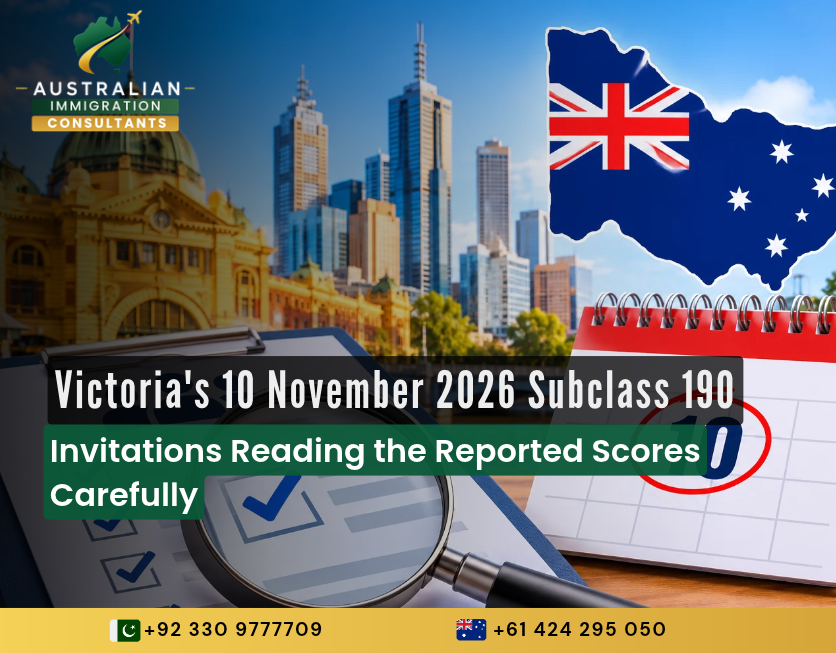
On Tuesday 10 November 2026, applicants started posting that they had received invitations to apply for Victorian nomination under the Skilled Nominated visa (subclass 190). Within hours, migration forums were full of scores and the same anxious question: is mine high enough?
Before comparing numbers, it helps to know how reliable they are, and what to do if your own invitation arrives.
The numbers come from applicants, not from Victoria
As of 11 November, the Victorian Government had not published anything about this round. Its news and program pages do not confirm that a round took place, how many invitations went out, or which occupations were invited.
Every score below therefore comes from applicants and migration agents. Gate Migration describes its own figures as unverified and incomplete. The SmartVisaGuide thread, which is crowdsourced, warns that its entries come from several sources and may contain discrepancies. One moderator there noted that people sometimes post a profile and later admit they were never invited. Read what follows as a rough snapshot, not an official result.
Where the 900 places fit in
Victoria’s 2026-27 program allocates 900 nomination places to subclass 190. That figure is the full-year quota, not the number of people invited on 10 November. Subclass 190 registrations of interest (ROIs) are open. Subclass 491 ROIs are closed while that allocation is not yet finalised.
What people reported, sector by sector
Most of the reports are from onshore applicants, with a few offshore.
Technology had the highest scores. A Developer Programmer reported 815, an ICT Security Specialist 803, and a Data Scientist (listed under Information and Organisation Professionals nec) 799. Other tech and business roles came in lower: Software Engineer at 727 and 758, Analyst Programmer at 744, and ICT Business Analyst at 730.
Business and professional roles were mid-range. A Taxation Accountant (still to be confirmed) reported 749, a Marketing Specialist 735, a Procurement professional (also under Information and Organisation Professionals nec) 733, and a Mechanical Engineer 730.
Health and education roles sat noticeably lower. Early Childhood Teacher reports ranged from 625 to 728. An offshore Registered Nurse (Surgical) reported 702, a Hospital Pharmacist 665, an offshore Secondary School Teacher 645, an Urban and Regional Planner 645, a Registered Nurse nec 624, and a Registered Nurse (Aged Care) 616.
Community services and trades had the lowest figures. Social Workers reported 611 (onshore) and 591 (offshore), a Welfare Worker working as a social worker 573, and a Motor Mechanic 565, the lowest in the whole sample.
Two things stand out. First, the spread is wide: from 565 to 815, depending on occupation. That is consistent with Victoria selecting through both a most-competitive pathway and priority-industry pathways, so different occupations can be invited at very different scores. Second, offshore applicants appear in the data, so living in Australia is not a requirement for being considered.
Expert guidance tailored to your unique journey. Get a personalized roadmap from a Registered Migration Agent today.Navigate Your Migration
With Confidence.
Why a reported score is not a cut-off
It is tempting to treat the lowest score in your occupation as the minimum you need. That is a mistake, for several reasons.
The sample is small and self-selected. It only includes people who chose to post, so an occupation that is missing from the list does not mean nobody in it was invited. The lowest reported score only shows that someone with that score said they were invited. It does not set a floor.
Victoria also has no fixed pass mark. Its Victorian Points Test (VPT) ranks ROIs using seven weighted factors, so your chances depend on who else is in the pool and how many places remain. A high score never guarantees an invitation either.
The VPT is separate from your SkillSelect score, and the two totals cannot be swapped. SmartVisaGuide notes that its EOI figures include state points, which is another reason to be careful when comparing.
A few applicants also shared personal details. One ICT Business Analyst reported 730 points with a Masters degree, Superior English, three years of experience, a AU$125k salary and an age of 30. These are anecdotes, but they hint at how earnings and English ability can lift a VPT total.
An invitation is only the start
Many people assume that an invitation means they are nearly done. It does not. Victoria’s process runs like this:
You first confirm that you meet both Home Affairs and Victorian requirements, then submit or update your SkillSelect EOI. Next, you lodge your ROI on the Live in Melbourne portal using your EOI number. An ROI is not a nomination application, and selection is not guaranteed. If you are invited, you submit a full nomination application through the portal with evidence for every claim; emailed submissions are not accepted. If you are nominated, you have 60 days to lodge your visa application with Home Affairs.
Victoria says nomination applications take about 20 business days on average to assess, not counting time spent waiting for further information. Applications are handled in the order received, and Victoria asks applicants not to chase for updates because it slows everyone down. You can track progress in the portal.
Eligibility, in plain terms
If you live in Australia, you must be living in Victoria. Victoria is not selecting onshore applicants who live in other states or territories, apart from limited case-by-case exceptions for border communities. Offshore applicants can be considered if they are genuinely committed to living in Victoria.
You must be under 45 when nominated and have at least Competent English, with the test still valid for at least 12 weeks when you lodge your nomination application. Your skills assessment must be valid, in an eligible occupation, match your SkillSelect EOI, and also have at least 12 weeks left. Health professionals need an occupation consistent with their AHPRA registration.
You do not need to be employed. If you are working onshore, though, you can only claim earnings from skilled employment with an employer physically located in Victoria. A virtual or proxy office does not count. You must also be committed to living and working in Victoria, and nominations cannot be transferred between states.
Documents to have ready
If you are invited, expect to supply your passport and evidence of Victorian residence, such as at least six months of bank statements, lease agreements, utility bills and a driver’s licence. If you claimed earnings, you will also need your employment contract, position description, at least four weeks of recent payslips and a superannuation statement. Submit everything unaltered, because Victoria verifies many documents by contacting employers and institutions directly.
What gets nominations refused
Victoria is open about the usual causes: overestimated earnings, ineligible employment or an employer not operating in Victoria, living in another state or territory, incorrect partner points, changing your SkillSelect EOI after being invited, false or misleading information, and expired skills assessments or English tests.
A refusal can mean waiting six months before you can lodge a new application, and false or misleading information may be reported to Home Affairs. Missing the 60-day visa deadline, or having errors in your EOI at the time of nomination, also rules out renomination in the same program year.
Life after nomination
Nominated applicants agree to live and work in Victoria for at least two years, keep their contact details up to date, and complete surveys on arrival and every six months during the two years after visa grant or arrival. The surveys do not affect your visa.
One more caution: you cannot appoint an agent if there is a personal, financial or other conflict of interest, for example an employer or family member with a stake in your outcome. If one is found, the appointment can be treated as invalid and the application refused.
What to do depending on where you stand
If you are still waiting, keep your SkillSelect EOI accurate. A submitted ROI cannot be edited, so changes mean withdrawing it and submitting a new one. Do not reshape your circumstances just to chase a score, because Victoria strongly discourages that and rules can change without notice. Rounds also do not follow a set monthly schedule.
If you have been invited, read the invitation email carefully and note the deadline. Collect evidence for every claim before you begin. Add the Live in Melbourne no-reply address to your safe senders list and check your junk folder, since failing to respond can lead to refusal.
Whatever your situation, treat the Live in Melbourne website as the authoritative source, because requirements and priorities can change at any time and apply immediately.
Until Victoria publishes its own results, the 10 November scores are best treated as talking points rather than targets. What you can control is the quality of your EOI and ROI, the strength of your evidence, and how ready your documents are when your turn comes.
FAQS
1. Has Victoria officially published the 10 November 2026 subclass 190 round results?
No, as of 11 November the Victorian Government had not confirmed the round, the total invitations or any occupation results, so all reported scores come from applicants.
2. What is the minimum score needed for a Victoria 190 invitation?
There is no fixed pass mark, because the Victorian Points Test ranks ROIs on seven weighted factors and reported scores in this round ranged from 565 to 815 depending on occupation.
3. Can offshore applicants get Victoria 190 nomination?
Yes, offshore applicants can be considered if they are committed to living in Victoria, while onshore applicants must already be living in Victoria.
4. How long does Victoria take to assess a 190 nomination application?
Victoria says assessment takes about 20 business days on average, not counting time spent waiting for additional information.
5. How long do I have to lodge my visa after Victoria nominates me?
You must lodge your visa application with the Department of Home Affairs within 60 days of nomination.
This article is general information only and not migration advice. Program requirements change, so check the official Live in Melbourne and Home Affairs websites and consider speaking with a registered migration agent about your circumstances.